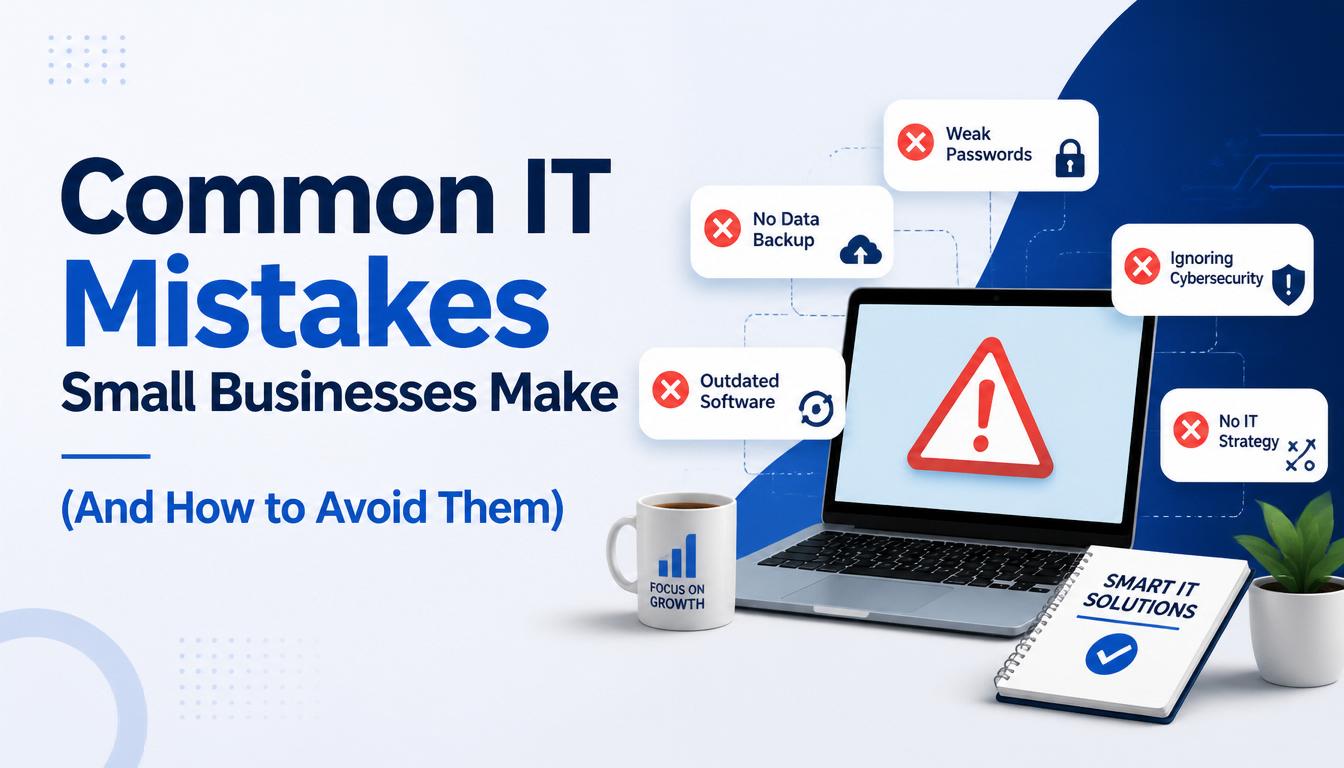
Cybersecurity is not only a concern for large corporations.
Small businesses rely on technology every day to communicate with customers, process payments, manage employees, store information, operate websites, and deliver products and services.
This reliance on technology also creates cybersecurity responsibilities.
Unfortunately, many small businesses make simple security mistakes that could expose their systems and information to unnecessary risks.
The good news is that many of these mistakes can be addressed with practical security measures.
Here are five cybersecurity mistakes small businesses should avoid.
1. Using Weak or Reused Passwords
Passwords are still one of the most important ways businesses protect their online accounts.
Unfortunately, employees may use passwords that are:
- Too short
- Easy to guess
- Reused across multiple accounts
- Shared with other people
- Based on personal information
If an attacker obtains a reused password, they may attempt to use it against other accounts.
How to Improve Password Security
Businesses should:
- Use strong and unique passwords.
- Avoid password sharing.
- Use a reputable password manager where appropriate.
- Enable multi-factor authentication.
- Regularly review privileged accounts.
- Remove unnecessary accounts.
Multi-factor authentication provides an additional layer of protection beyond the password itself.
2. Ignoring Software Updates
Software updates are often treated as an inconvenience.
Employees may click "Remind me later" repeatedly, while businesses may continue running old versions of websites, plugins, applications, or operating systems.
This can leave known vulnerabilities unresolved.
Why Updates Matter
Software updates may include:
- Security patches
- Bug fixes
- Performance improvements
- Compatibility improvements
- Stability improvements
Businesses should establish a process for keeping important software and systems appropriately updated.
This includes websites, servers, operating systems, plugins, applications, network devices, and software dependencies.
3. Failing to Back Up Important Data
Imagine losing your customer database, financial records, website files, or important business documents.
Without reliable backups, recovering that information may be extremely difficult.
Data can be lost through:
- Ransomware
- Hardware failure
- Accidental deletion
- Human error
- Software problems
- Theft
- Physical damage
How to Improve Your Backup Strategy
Identify the information your business cannot afford to lose.
Then establish appropriate backups and determine:
- What should be backed up?
- How often should backups occur?
- Where should backups be stored?
- Who can access them?
- How long should they be retained?
- How will the data be restored?
Most importantly, test your backups.
A backup that cannot be restored when needed may provide a false sense of security.
4. Failing to Train Employees
Employees are an important part of cybersecurity.
Even with strong technical controls, an employee can accidentally create a security problem by clicking a malicious link, downloading a dangerous attachment, revealing credentials, or sending sensitive information to the wrong person.
Cybercriminals frequently use social engineering and phishing techniques to manipulate people.
What Should Employees Learn?
Regular cybersecurity awareness training should cover:
- Phishing emails
- Suspicious links
- Fake login pages
- Malicious attachments
- Password security
- Social engineering
- Fraudulent payment requests
- Safe use of company devices
- Reporting suspicious activity
Employees should also know who to contact when they believe something has gone wrong.
The goal is not to make employees cybersecurity experts. It is to give them the knowledge needed to recognize common threats and respond appropriately.
5. Waiting Until Something Goes Wrong
Perhaps the most serious mistake is treating cybersecurity as something to worry about after an incident.
Some businesses only start thinking seriously about security after:
- Their website has been hacked
- An email account has been compromised
- Important files have disappeared
- A customer database has been exposed
- Money has been lost
- A critical system has stopped working
By then, the business is responding under pressure.
Build a Basic Cybersecurity Strategy
Businesses should establish basic security practices before an incident occurs.
Start by identifying:
- What information needs protection
- Which systems are critical
- Who has access
- What cybersecurity risks exist
- How important data is backed up
- How employees are trained
- What happens during a security incident
A basic cybersecurity strategy can give the business a clearer path for preventing, detecting, responding to, and recovering from incidents.
Other Cybersecurity Mistakes to Watch
The five mistakes above are common, but businesses should also pay attention to other areas.
Giving Everyone Administrator Access
Employees should generally receive only the access required for their roles.
Using Unsupported Software
Software that no longer receives security updates can create additional risk.
Ignoring Website Security
Business websites should be regularly maintained, updated, monitored, and protected.
Leaving Former Employees' Accounts Active
When employees leave an organization, their access should be reviewed and removed where appropriate.
Using Unsecured Devices
Company laptops, smartphones, and other devices can contain sensitive information and should be protected appropriately.
Having No Incident Response Plan
Businesses should know what to do when an account, device, application, or system is compromised.
A Simple Cybersecurity Checklist for Small Businesses
Start with these basic measures:
You do not need to implement everything overnight.
Start with the highest-risk areas and improve your security progressively.
Cybersecurity is Everyone's Responsibility
Cybersecurity should not be the responsibility of only one employee or the IT department.
Business owners, managers, employees, developers, administrators, and technology providers all have roles to play.
A strong cybersecurity culture begins when everyone understands that protecting business information and systems is part of protecting the business itself.
Final Thoughts
Small businesses may not have the same resources as large corporations, but they can still establish strong cybersecurity foundations.
Avoiding simple mistakes such as weak passwords, outdated software, inadequate backups, poor employee awareness, and a lack of preparation can significantly improve a business's security posture.
Cybersecurity does not have to be complicated.
Start with the basics, identify your risks, protect your most important systems and information, and continue improving as your business grows.
At SOAR INNOVATIVE TECHNOLOGY, we help businesses strengthen their digital infrastructure through cybersecurity, IT support, software development, website and software maintenance, cloud solutions, and other technology services.
Want to improve your business's cybersecurity?
Talk to SOAR INNOVATIVE TECHNOLOGY about your security requirements and discover practical technology solutions for your business.

Leave a Reply
Your email address will not be published. Required fields are marked *